Long time no writing on this blog. The main reason is lack of time due to the start of our campaign and also because I had some “bad” news. The job I am currently doing is a replacement. I always kind of thought she wouldn’t come back to her old job but she has decided a couple of weeks ago that she would. Therefore I have to find a new job. Some might find that exciting, the start of a new thing. I kind of hoped to have a job for more than one year for once. I feel like the last 7 years I have applied more than worked. A few years ago it came to the point that I was sending out more than 50 cv’s a week. Just in order to get a job that would pay the rent basically.
I like my job now. They are things that I miss in my current job. I don’t write as much as I would like to. Personal initiative is kind of minimal. But the environment and the people I work with are great. It’s very interesting, I feel like my job as a purpose and the pay is good for an NGO.
So now it’s back to square one. Or not completely. Difference between now and a couple of years ago is that my cv is getting better and that I get interviews. So that’s why I am writing this blog from Geneva. I went there for an interview for the same NGO I am currently working for but a different section. It would be much more medical, I would write a lot more, initiative would be required. Only problem: it’s based in Geneva. And I don’t really know if I want to go there. For a year I wouldn’t mind, but I can’t see myself live there longer. It’s extremely quiet, people don’t seem to go out that much (how could they afford it anyway) and surprisingly it’s not the beautiful town I thought t was going to be. The old part is very nice but near the office it’s a bit like you’re stranded in the 60 in Eastern Europe.
There’s also the matter of my apartment in Brussels that I just bought, friends that I would miss… So a lot to think about for the next couple of days. But it’s early days yet, I don’t even know if I have the job… ;-)
Friday, 13 July 2007

Thursday, 14 June 2007
The story of the foot
So it's been two weeks and my ankle was still in pain on Monday. So much that I thought the worst. Luckily there was a spot open to see the doctor immediately. And what has happened is too silly for words. My ligament is actually quite ok now. It's still a tiny torn but that shouldn't hurt so much. The pain is due more to the fact that I have been still for a week, trying to walk on it as little as possible. That was the doctor's order from the other clinic.
The result? My Achilles tendon (ok I had to look that one up - my English is not that good) is a little bit confused with me not walking anymore and has become lazy. You can laugh but that actually hurts as well. New orders from the doctor: walk normally, do some stretching and massages so that the blood goes back to my foot and that my muscles tend to be more supple.
Good news is: it works... Yesterday was a bit painful but today is already so much better.
Bad news: more and more I realise I actually should have succeeded in my medical studies.... At least I wouldn't have to go to various doctors with different diagnostic each time....
You live and learn.
The result? My Achilles tendon (ok I had to look that one up - my English is not that good) is a little bit confused with me not walking anymore and has become lazy. You can laugh but that actually hurts as well. New orders from the doctor: walk normally, do some stretching and massages so that the blood goes back to my foot and that my muscles tend to be more supple.
Good news is: it works... Yesterday was a bit painful but today is already so much better.
Bad news: more and more I realise I actually should have succeeded in my medical studies.... At least I wouldn't have to go to various doctors with different diagnostic each time....
You live and learn.
Tuesday, 5 June 2007
Life on crutches....
After years of skiing, snowboarding, swimming, running, playing tennis, it’s a miracle that I haven’t hurt myself sooner. However life on crutches is not as fancy and fun as I imagined. Beside the fact that my ankle actually hurts quite a lot, I am not managing those crutches as well as I would like to. I don’t know how people manage to look cool with them but I nearly fall every time I take a step. It's difficult to open a door, take a shower, ...Also, my other leg is now killing me.
Anyway, my own dumb mistake; should have trained more…. And I shouldn’t complain too much: it’s not the end of the world and I can stay home another day tomorrow. Yippee
Anyway, my own dumb mistake; should have trained more…. And I shouldn’t complain too much: it’s not the end of the world and I can stay home another day tomorrow. Yippee
Monday, 4 June 2007
20km and one torn ligament later….

I did it!!! Ok, it took me 2 hours 49 minutes and 30 seconds but I did it. And I have a medal to prove it. Sadly now I have a torn ligament in my ankle and can’t really walk anymore.
Last Monday, the day after the 20km in Brussels, my legs were killing me. I thought that was pretty normal considering the amount of sports I had suddenly done compared to the last 28 years of my life. So I wasn’t that sussed about it. In the afternoon however, my ankle was killing me and I was incapable to walk on it. I thought I just had strained my muscle and didn’t want to be a sissy so I left it at that.
Today, a week later, and because my doctor told me to, I decided it was about time to go to the emergency room. Diagnosis: a torn ligament, 3 days in bed, one week on crutches…
I thought sports were supposed to be healthy… Thank god for 24, Desperate housewives and Prison break….
Last Monday, the day after the 20km in Brussels, my legs were killing me. I thought that was pretty normal considering the amount of sports I had suddenly done compared to the last 28 years of my life. So I wasn’t that sussed about it. In the afternoon however, my ankle was killing me and I was incapable to walk on it. I thought I just had strained my muscle and didn’t want to be a sissy so I left it at that.
Today, a week later, and because my doctor told me to, I decided it was about time to go to the emergency room. Diagnosis: a torn ligament, 3 days in bed, one week on crutches…
I thought sports were supposed to be healthy… Thank god for 24, Desperate housewives and Prison break….
Thursday, 17 May 2007
Liberia - last days
Monday – Tuesday - Wednesday 14th – 15th – 16th May
 Tuesday morning in our clinic at New Kru Town. The waiting room is packed. It's very hot, smelly, noisy and about 200 patients want to see a doctor. Around 11 women gave birth during the night or in the early hours and therefore have to share their beds. At least two women per bed with their newborn baby. And we complain when we can't have a bed in a single room back home! Another 5 women are in labour in the other room.
Monday is usually the busiest day of the week. Liberians don't like to come on a Friday I am told. Work, looking food, lack of money, ignorance about the severity of their condition and probably the idea of the weekend puts them off of going to the hospital. However Monday 14th was Independence Day and the clinic was closed. So now Tuesday it's even worse than any other Monday.
Sofie and I decided to follow a patient. Theresa is 27 years old and suffers from high fever and acute headache. She arrived around 7.30 in the morning to get a number to see the doctor. By noon she's still in the waiting room. I have trouble staying there and I am not the one with an excruciating headache. It's noisy because the nurses keep on shouting numbers, babies are crying, people are talking loudly, it's even hotter than in the morning and the air is missing. Theresa is a typical malaria case, or at least that's what we suspect. Malaria is more and more frequent around this time of the year. Most people who come to the clinic are treated for this condition that is life threatening. Symptoms are a very high fever, chills and headache. If you leave it untreated, you can start convulsing, fall in a coma and die.
While Theresa is waiting just to see a doctor, Sofie and I go to the family planning. This is a program that is working very well. Women who have just given labour are advised to rest a little before they have a new baby. This is good for the mum but also for the newborn as it will breastfeed longer. Teenage girls who don't want to become pregnant also come here to get their free pill. One girl, 16 years old, came just to get her pill but during the consult we realise that she is shivering. I put my hand on her forehead, she is burning. Probably malaria. The nurse tells us where she needs to go and probably because Sofie and I were with her she is treated immediately. Well immediately is a vast conception. The result for the simple malaria test is negative and so they have to do a smear. Christiana will have to wait another 3 hours before it's confirmed she's indeed suffering from malaria and receive proper medication.
It's not the staff's fault. They are highly qualified, do a really good job, but they're just too many people. The corridors, the benches, the waiting rooms, the floors, everywhere it's packed with people waiting. Most of them wait for hours.
Theresa is still in triage. It's now 2.30 and she still hasn't seen a doctor. She's got number 108 and they're not there yet. I could have found a patient with a smaller number but I want to know I long it takes to see a doctor here. So far Theresa has had to wait for 6 and a half hours!
Theresa has nothing to read, she basically can't read anyway. She is staring quietly , not moving as she is scared she might lose her seat. Interviewing people in Liberia is not easy. They're friendly and very happy to talk to you but their English is so different from mine. They don't really understand my English and I have trouble with theirs. Somehow over the last week it's easier cos I am getting used to it but still. Here they call it pidgin English. Antenatal care is called "belly check", "passing poopoo" is diarrhoea, titty water is breast milk etc… Another difficult thing is that most people actually have no idea how old they are and how old their children are. For me, Western girl, absolutely obsessed by time it's the most difficult thing to grasp. They're usually in between ages. "I am in between 25 and 30 years old, my baby girl is about 5 to 6 months". Sometimes you definitively see that the baby girl is closer to one than to 7 months but most of the time it's hard to say.
This is a major problem when it comes to vaccination. Some vaccines can only be given after 5 months. Doctors therefore usually ask questions regarding the season, the sun and determine if the baby is old enough. You have to find a solution to everything here.
With the rape victims I have interviewed today, it's the same problem. They usually don't know when they have been raped. You have to kind of guess according to historic events. The woman today was raped somewhere during the first world war so probably around 1990-1992. As she told us she was married at that time we also determined her age: around 35 (and not 27 as she thought she was). Time is a different conception around here.
Theresa will finally see a doctor around 2.45 (yes I have a watch). Her malaria test is negative but her urine test is positive. She's got a urinary infection. She should have come on Friday when she had the first symptoms. That's why today (4 days later) she's got fever, pain in her lower back (due to the kidneys). But the main thing is that with strong antibiotics she'll be ok. So back to another waiting line: the pharmacy. About 25 people are before her in the queue. It will probably take another 30 to 45 minutes.
I can't stick around cos we have an emergency. A little boy with malaria is unconscious and needs to be transferred by ambulance to our other hospital. The mum is crying in despair, we rush to the hospital with An the midwife.
In Island hospital, doctors are immediately attending to him, I'm taking the mum to registration and trying to calm her down, reassuring her a bit. A few minutes later a nurse and I are putting the boy in a tub and put cold water on him to get the fever down and get him conscious. The boy will be fine but again it proves that sadly people wait too long before coming to hospital. Of course it's not their fault. They don't know, have no money. They're just trying to survive.
 On a more personal note, I have been running a little bit in Monrovia. Never thought it to be possible as security is very tight but it is as long as you have a guy with you. So I have been running twice: once to Africa hotel (in the pre-war glory day the most beautiful hotel in the city) and to the beach. It's quite surreal to run here but it was nice. Also, Sam, the watsan (water and sanitation) specialist has taken us for dinner last night. We went to New Jack's, local bar/restaurant in downtown Monrovia run by Myriam, a Liberian woman married to an Oxfam employee. Her mum was there and told us about Liberia's history, the wars and the problem this country is facing today. It was nice to get an "inside" perspective. And if you ever go on holiday here, and hopefully one day it will be possible, it's the best food in town!
 Tuesday morning in our clinic at New Kru Town. The waiting room is packed. It's very hot, smelly, noisy and about 200 patients want to see a doctor. Around 11 women gave birth during the night or in the early hours and therefore have to share their beds. At least two women per bed with their newborn baby. And we complain when we can't have a bed in a single room back home! Another 5 women are in labour in the other room.
Monday is usually the busiest day of the week. Liberians don't like to come on a Friday I am told. Work, looking food, lack of money, ignorance about the severity of their condition and probably the idea of the weekend puts them off of going to the hospital. However Monday 14th was Independence Day and the clinic was closed. So now Tuesday it's even worse than any other Monday.
Sofie and I decided to follow a patient. Theresa is 27 years old and suffers from high fever and acute headache. She arrived around 7.30 in the morning to get a number to see the doctor. By noon she's still in the waiting room. I have trouble staying there and I am not the one with an excruciating headache. It's noisy because the nurses keep on shouting numbers, babies are crying, people are talking loudly, it's even hotter than in the morning and the air is missing. Theresa is a typical malaria case, or at least that's what we suspect. Malaria is more and more frequent around this time of the year. Most people who come to the clinic are treated for this condition that is life threatening. Symptoms are a very high fever, chills and headache. If you leave it untreated, you can start convulsing, fall in a coma and die.
While Theresa is waiting just to see a doctor, Sofie and I go to the family planning. This is a program that is working very well. Women who have just given labour are advised to rest a little before they have a new baby. This is good for the mum but also for the newborn as it will breastfeed longer. Teenage girls who don't want to become pregnant also come here to get their free pill. One girl, 16 years old, came just to get her pill but during the consult we realise that she is shivering. I put my hand on her forehead, she is burning. Probably malaria. The nurse tells us where she needs to go and probably because Sofie and I were with her she is treated immediately. Well immediately is a vast conception. The result for the simple malaria test is negative and so they have to do a smear. Christiana will have to wait another 3 hours before it's confirmed she's indeed suffering from malaria and receive proper medication.
It's not the staff's fault. They are highly qualified, do a really good job, but they're just too many people. The corridors, the benches, the waiting rooms, the floors, everywhere it's packed with people waiting. Most of them wait for hours.
Theresa is still in triage. It's now 2.30 and she still hasn't seen a doctor. She's got number 108 and they're not there yet. I could have found a patient with a smaller number but I want to know I long it takes to see a doctor here. So far Theresa has had to wait for 6 and a half hours!
Theresa has nothing to read, she basically can't read anyway. She is staring quietly , not moving as she is scared she might lose her seat. Interviewing people in Liberia is not easy. They're friendly and very happy to talk to you but their English is so different from mine. They don't really understand my English and I have trouble with theirs. Somehow over the last week it's easier cos I am getting used to it but still. Here they call it pidgin English. Antenatal care is called "belly check", "passing poopoo" is diarrhoea, titty water is breast milk etc… Another difficult thing is that most people actually have no idea how old they are and how old their children are. For me, Western girl, absolutely obsessed by time it's the most difficult thing to grasp. They're usually in between ages. "I am in between 25 and 30 years old, my baby girl is about 5 to 6 months". Sometimes you definitively see that the baby girl is closer to one than to 7 months but most of the time it's hard to say.
This is a major problem when it comes to vaccination. Some vaccines can only be given after 5 months. Doctors therefore usually ask questions regarding the season, the sun and determine if the baby is old enough. You have to find a solution to everything here.
With the rape victims I have interviewed today, it's the same problem. They usually don't know when they have been raped. You have to kind of guess according to historic events. The woman today was raped somewhere during the first world war so probably around 1990-1992. As she told us she was married at that time we also determined her age: around 35 (and not 27 as she thought she was). Time is a different conception around here.
Theresa will finally see a doctor around 2.45 (yes I have a watch). Her malaria test is negative but her urine test is positive. She's got a urinary infection. She should have come on Friday when she had the first symptoms. That's why today (4 days later) she's got fever, pain in her lower back (due to the kidneys). But the main thing is that with strong antibiotics she'll be ok. So back to another waiting line: the pharmacy. About 25 people are before her in the queue. It will probably take another 30 to 45 minutes.
I can't stick around cos we have an emergency. A little boy with malaria is unconscious and needs to be transferred by ambulance to our other hospital. The mum is crying in despair, we rush to the hospital with An the midwife.
In Island hospital, doctors are immediately attending to him, I'm taking the mum to registration and trying to calm her down, reassuring her a bit. A few minutes later a nurse and I are putting the boy in a tub and put cold water on him to get the fever down and get him conscious. The boy will be fine but again it proves that sadly people wait too long before coming to hospital. Of course it's not their fault. They don't know, have no money. They're just trying to survive.
 On a more personal note, I have been running a little bit in Monrovia. Never thought it to be possible as security is very tight but it is as long as you have a guy with you. So I have been running twice: once to Africa hotel (in the pre-war glory day the most beautiful hotel in the city) and to the beach. It's quite surreal to run here but it was nice. Also, Sam, the watsan (water and sanitation) specialist has taken us for dinner last night. We went to New Jack's, local bar/restaurant in downtown Monrovia run by Myriam, a Liberian woman married to an Oxfam employee. Her mum was there and told us about Liberia's history, the wars and the problem this country is facing today. It was nice to get an "inside" perspective. And if you ever go on holiday here, and hopefully one day it will be possible, it's the best food in town!
Monday, 14 May 2007
Weekend in Liberia
Saturday – Sunday 13th May
It's the weekend and so operations are a bit slow. Saturday I was invited at a wedding. Two members of the staff were getting married. One British girl with an Ethiopian man. In the morning Céline, Sofie and I went to chill out on the beach and get a tan. Well at least for Céline and Sofie. I just get either red or stay completely white. As I want some colour, I just stay in the sun. Result: I am red and have some spots on my face. Hopefully it will go away before I get back.
Talking about getting back… This is going to be difficult. I really like it here. The staff is great, expats and nationals, they made me feel more than welcome. I am not counting the days when Wednesday comes and I will have to catch the plane to Brussels. I am happy to see my friends and family back but also really like my job here. I hope I'll get the chance to go back on the field soon.
The wedding was set on Golden Beach in the centre of Monrovia. The sea there is completely different from the one that we usually go to (Cece beach). It's impossible to swim there as it's rough and dangerous. It was a really nice buffet and it was a good opportunity to speak to the staff in a different setting than just plain work.
I also had the chance to speak more extensively with the national staff. I wanted to know how they live, how they spend their days outside the NGO, how they saw the future, if things had changed since the war. They wanted to what Belgium was, like how I live and why white women are so scared of spiders .
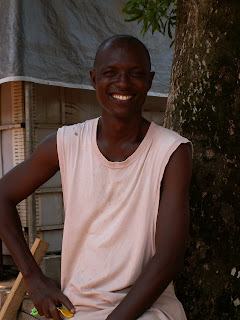 Blackie, one of the national staff, invited me for the next morning to his church as I wanted to know how an African mass is celebrated.
The next morning I took the car downtown to an area where probably it's rare for "white" people to go. Blackie was waiting for me, all dressed up and proud that I would do the honour to visit his church. He had even warned the pastor that I was coming. African mass is very different from what we know. First you get the pastor to preach and then they basically sing and dance for nearly two hours. What's not different is that they have to give money to the pastor. For a population that's living on less than 1 dollar a day, they surely give a lot to the church. Blackie explains to me later that it's only because they actually don't have a church. It's kind of a small house with bullet holes (probably a leftover from the war in 2003) and a metal roof. No more than 15 people can sit in it but the community is growing so they need to move, hence the money… Hum
Houses are as scarce in Liberia as is clean water. They're a few from the glory days before the war and rarely inhabited by Liberians. Most "houses" are either ship containers that European companies just dumped, in "full" wood or "small" wood. Don't really know how the explain it correctly but some houses are entirely in wood, others just have four wood sticks and a metal roof.
Apart from being extremely hot, Liberia is one of the most humid countries in Africa, if not the most. It rains here regularly and when we complain in Belgium about a heavy rain shower, just come here and see hell break in the sky. It's amazing. But not for the people living in the wooden houses. After a rainy night you can see that it has rained inside their houses. You also have to imagine that they haven't got a running water system (nor toilet system) and no electricity (some have generators). The morning after the rain the smell inside the city is quite indescribable.
Cars are also a big issue. People have no money to buy a car and mostly take the cab. You have to imagine that yellow cabs are not taking one person but several people. They just hop in along the way, mostly four people cramped in the back, three in the front.
Africa can be considered as Europe's dustbin. Well at least Liberia, I haven't been to all the other countries and wouldn't call myself and African connoisseur. They get the t-shirts we can't sell anymore, the toys we wouldn't give to our children etc. The worst are the cars. If you ever wondered were your 13 year-old car is, well now you have the answer: it's in Africa polluting the atmosphere. I saw a car with a smap (Belgium insurance company now called something else) sticker on the back and one with a Kortrijk (a city in Belgium) sticker. A vast majority of the cars (used as cabs, Liberians rarely have a car) also have stickers at the back showing what country they're from (B for Belgium, CH for Switzerland, NL for the Netherlands are the most popular).
As a result, Monrovia is extremely polluted and it's sometimes hard to breathe when stuck in traffic. All this time we are lobbying for the environment and at the same time we dump our old, polluting cars on the poorest.
For those who are interested in reading more about Liberia and the NGO's, an actual writer has actually written a very good piece in the Observer. "Letter from Liberia", Zadie Smith, 29 April 2007. Go and check it, it's brilliant.
It's the weekend and so operations are a bit slow. Saturday I was invited at a wedding. Two members of the staff were getting married. One British girl with an Ethiopian man. In the morning Céline, Sofie and I went to chill out on the beach and get a tan. Well at least for Céline and Sofie. I just get either red or stay completely white. As I want some colour, I just stay in the sun. Result: I am red and have some spots on my face. Hopefully it will go away before I get back.
Talking about getting back… This is going to be difficult. I really like it here. The staff is great, expats and nationals, they made me feel more than welcome. I am not counting the days when Wednesday comes and I will have to catch the plane to Brussels. I am happy to see my friends and family back but also really like my job here. I hope I'll get the chance to go back on the field soon.
The wedding was set on Golden Beach in the centre of Monrovia. The sea there is completely different from the one that we usually go to (Cece beach). It's impossible to swim there as it's rough and dangerous. It was a really nice buffet and it was a good opportunity to speak to the staff in a different setting than just plain work.
I also had the chance to speak more extensively with the national staff. I wanted to know how they live, how they spend their days outside the NGO, how they saw the future, if things had changed since the war. They wanted to what Belgium was, like how I live and why white women are so scared of spiders .
 Blackie, one of the national staff, invited me for the next morning to his church as I wanted to know how an African mass is celebrated.
The next morning I took the car downtown to an area where probably it's rare for "white" people to go. Blackie was waiting for me, all dressed up and proud that I would do the honour to visit his church. He had even warned the pastor that I was coming. African mass is very different from what we know. First you get the pastor to preach and then they basically sing and dance for nearly two hours. What's not different is that they have to give money to the pastor. For a population that's living on less than 1 dollar a day, they surely give a lot to the church. Blackie explains to me later that it's only because they actually don't have a church. It's kind of a small house with bullet holes (probably a leftover from the war in 2003) and a metal roof. No more than 15 people can sit in it but the community is growing so they need to move, hence the money… Hum
Houses are as scarce in Liberia as is clean water. They're a few from the glory days before the war and rarely inhabited by Liberians. Most "houses" are either ship containers that European companies just dumped, in "full" wood or "small" wood. Don't really know how the explain it correctly but some houses are entirely in wood, others just have four wood sticks and a metal roof.
Apart from being extremely hot, Liberia is one of the most humid countries in Africa, if not the most. It rains here regularly and when we complain in Belgium about a heavy rain shower, just come here and see hell break in the sky. It's amazing. But not for the people living in the wooden houses. After a rainy night you can see that it has rained inside their houses. You also have to imagine that they haven't got a running water system (nor toilet system) and no electricity (some have generators). The morning after the rain the smell inside the city is quite indescribable.
Cars are also a big issue. People have no money to buy a car and mostly take the cab. You have to imagine that yellow cabs are not taking one person but several people. They just hop in along the way, mostly four people cramped in the back, three in the front.
Africa can be considered as Europe's dustbin. Well at least Liberia, I haven't been to all the other countries and wouldn't call myself and African connoisseur. They get the t-shirts we can't sell anymore, the toys we wouldn't give to our children etc. The worst are the cars. If you ever wondered were your 13 year-old car is, well now you have the answer: it's in Africa polluting the atmosphere. I saw a car with a smap (Belgium insurance company now called something else) sticker on the back and one with a Kortrijk (a city in Belgium) sticker.
A vast majority of the cars (used as cabs, Liberians rarely have a car) also have stickers at the back showing what country they're from (B for Belgium, CH for Switzerland, NL for the Netherlands are the most popular).As a result, Monrovia is extremely polluted and it's sometimes hard to breathe when stuck in traffic. All this time we are lobbying for the environment and at the same time we dump our old, polluting cars on the poorest.
For those who are interested in reading more about Liberia and the NGO's, an actual writer has actually written a very good piece in the Observer. "Letter from Liberia", Zadie Smith, 29 April 2007. Go and check it, it's brilliant.
Sunday, 13 May 2007
Liberia 4
Friday 11th May
I already told you that Liberia has a high number of rape victims. For this my NGO has set up a special sexual violence program. One of the key person in this program is Angie, the psychologist. She's training 3 social workers who counsel the rape victims. Two for the adults and one for the children. Raping children is quite common here as well.
The 2003 civil war but also before (they refer it has world war I&II – between 1989 and 1997) has made rape a "natural" thing. Many women, children were raped by the rebels and the army. Today, the perpetrators have still not been punished and rape is still very much part of their daily life. We also went to see the Female Lawyers association ,which is helping to change the rape and gender based violence law. Slowly the country is changing but it will take years before the rape stops altogether.
Interviewing rape victims, especially children is extremely hard. I begin to get the impression that I am this white girl coming to Liberia to hear all the miseries of the world and then is going to go back home to my comfortable daily life and routine. And worst part is: it's true. Next Wednesday I'll be back home. These people still have to live in terrible conditions. I'll just worry about what to wear on my next date. I have these extremely mixed feelings: I feel guilty and at the same time I can't take all the misery of the world on me. Already I am helping a little bit by raising awareness of what is happening here. A beautiful country with very capable people that have sadly been living in a country destroyed by 20 years of civil war. They have to start everything back from scratch.
Despite all that, there is hope. This morning we went to the delivery room of the hospital we work at. A lot of women were in labour but as I have learnt over the last few days, it can sometimes take hours before they actually have their baby. But this morning we were lucky: 4 babies were born. And all boys! One woman even had twins. All perfectly healthy babies. So good to see this especially after the last few days.
I was a bit apprehensive with the labour. Probably I'll go through it one day and somehow I thought that seeing a delivery would put me of the idea. But it was great. Ok, it's very impressive and the first one is not scary, not gross but at the same time scary and gross (if you get what I mean). But by the second one (very quick one) and then the twins it was totally natural. The women don't really make a big deal out of it. They don't scream their lungs off (and we don't give pain killers), they just moan a little and some sing. In general it's a silent business. Very reassuring for the day I'll go through this myself :-)
I already told you that Liberia has a high number of rape victims. For this my NGO has set up a special sexual violence program. One of the key person in this program is Angie, the psychologist. She's training 3 social workers who counsel the rape victims. Two for the adults and one for the children. Raping children is quite common here as well.
The 2003 civil war but also before (they refer it has world war I&II – between 1989 and 1997) has made rape a "natural" thing. Many women, children were raped by the rebels and the army. Today, the perpetrators have still not been punished and rape is still very much part of their daily life. We also went to see the Female Lawyers association ,which is helping to change the rape and gender based violence law. Slowly the country is changing but it will take years before the rape stops altogether.
Interviewing rape victims, especially children is extremely hard. I begin to get the impression that I am this white girl coming to Liberia to hear all the miseries of the world and then is going to go back home to my comfortable daily life and routine. And worst part is: it's true. Next Wednesday I'll be back home. These people still have to live in terrible conditions. I'll just worry about what to wear on my next date. I have these extremely mixed feelings: I feel guilty and at the same time I can't take all the misery of the world on me. Already I am helping a little bit by raising awareness of what is happening here. A beautiful country with very capable people that have sadly been living in a country destroyed by 20 years of civil war. They have to start everything back from scratch.
Despite all that, there is hope. This morning we went to the delivery room of the hospital we work at. A lot of women were in labour but as I have learnt over the last few days, it can sometimes take hours before they actually have their baby. But this morning we were lucky: 4 babies were born. And all boys! One woman even had twins. All perfectly healthy babies. So good to see this especially after the last few days.
I was a bit apprehensive with the labour. Probably I'll go through it one day and somehow I thought that seeing a delivery would put me of the idea. But it was great. Ok, it's very impressive and the first one is not scary, not gross but at the same time scary and gross (if you get what I mean). But by the second one (very quick one) and then the twins it was totally natural. The women don't really make a big deal out of it. They don't scream their lungs off (and we don't give pain killers), they just moan a little and some sing. In general it's a silent business. Very reassuring for the day I'll go through this myself :-)
Subscribe to:
Posts (Atom)


