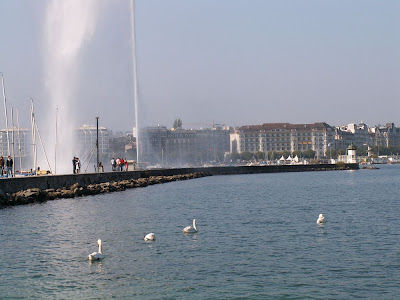
Sunday, 16 December 2007

Three months

Three months since Friday that my dad has died, and not one day without thinking about it. Until now I have never really found the words to express what I feel and I am not sure I do now. So why try to lay down my feelings about this today? In a couple of hours I’ll be 29 and this is my first birthday without my dad. I received birthday cards from my mum and step dad and from my grand father. They were so sweet but also a reminder that this year my dad won’t send me one. It will also soon be the first Christmas, the first New Year, his first birthday and before I know it, it will be the first anniversary of his death. A series of “first” then “seconds” etc; days that will never have the same significance as before. Days that will be tainted with a loss.

Coming to Geneva was probably the best thing to do for my mental sanity but it makes it also harder. Brussels would have been business as usual. Geneva is different. Different job, challenges, friends, life style, experience, all of which I wish I could share with him and can’t anymore. I still remember the day I arrived here, Sunday 7th October, sending a text message to my mum to tell her I arrived safely and then nearly sending it to my dad. I also remember not been able to sleep the first month I lived here. Worried about all the stupid paperwork but also because I kept dreaming about him, waking up in sweat convinced it was all a bad dream and that he was still alive. Except he isn’t. I can’t send him text messages about what I am doing here, about the challenges in my new job, the beautiful place I live in, the friends I made. The hardest until now was the week that I was working at the UN. I think he would have been proud of me had he known.

I know that time is a great healer and that over time it will all be easier. My mum, step dad and friends have all been extremely supportive and I wouldn’t have made it without their help. Also, as I said before, it’s the first for everything so the loss is emphasized. Those “special” days will never really be the same anyway. But what if I forget? What if one day, it’s the 14th of September and I completely forget it’s the day my dad died. Or I forget his birthday.

I miss you dad, and I wish you were here.

Monday, 26 November 2007

Geneva - the job

I haven’t talked about the job yet. As previously said, I work as a press officer in an NGO. Can’t say which one cos they’re not always in favour of uncontrolled blogs and also it doesn’t matter that much. Currently I am working for a campaign that aims to influence national and international policy makers to improve access to treatment and stimulate innovation of new medicines and diagnostic tools for developing countries.

Or an easier to put it is: before 2000, treating someone who was HIV positive cost 10.000 US$ per year. After years of advocacy and negotiations, the price is now around 300US$ per year, still too expensive for the patient but affordable for us, even though we wished it was still cheaper.

Two weeks ago, I participated at the IGWG meeting, the intergovernmental working group on public health, innovation and intellectual property. Intellectual property in the form of patents prevents developing countries to have access to essential medicines. Patents keep the drugs prices artificially high, as one manufacturer keeps a monopoly on the product and can decide of its price. My NGO wants to separate the cost of research and development of the medicine from the price of the drug. We are not against patents; we are against their effect.

The pharmaceutical industry, one of the most lucrative industries in the world, argues that they need the money brought by patents to fund their research. However, of the 1556 new drugs approved between 1975 and 2004, only 21 (1,3%) were specially developed for tropical diseases and TB, which account for 10% of the global disease burden (to read more).

TB is a very good example of how R&D (research and development) needs to be reconsidered. Tuberculosis claims 2 million deaths each year – almost 4 lives every minute – and two billion people (one third of the population) carry the bacilli. Most of them will not develop the disease as it is triggered by a low immune system. But a low immune system is a characteristic in HIV infected people. TB is the number one killer of HIV infected patients. For a couple of years now the TB community has been faced with another problem: resistant strains of TB. “Normal” TB can be cured and the drugs are efficient, though the cure is very long and difficult (up to 8 months), when you live in Belgium where social security is good you can manage; it’s going to be though but manageable. In developing countries where often the choice is between working and bringing food to the table or getting cured, it’s impossible. Resistant strains can only be cured with highly toxic medication with awful side effects, banned years ago because too dangerous. The R&D in TB is scares. Why? Because it’s not a highly profitable disease.

In the West, people infected with TB will rarely develop a resistance because they will get cured easily. In developing countries, patients don’t get diagnosed on time or cannot take their medication properly.

Another example is children infected with HIV. This problem nearly doesn’t appear anymore in the developed countries, as the antenatal care is good, mother are given proper medication and give birth by caesarian to prevent mother-to-child transmission. Therefore research in drugs to cure children infected with the virus have not really been developed. Doctors in our field project used to break adult tablets to give to the children; or they gave syrup that tasted awfully and sometimes even needed refrigeration! After years of advocacy R&D in drugs for infected children is finally getting somewhere.

Patents have been created to protect someone’s invention. You put hard labour into inventing or creating something and as a reward you get a protection for a certain period that prevent anybody to copy your work without permission, acknowledgment or royalties. This also allows the inventor of putting a price on his product. We don’t see how much a drug really costs as with our social security, the government is paying the difference. So a drug that we think costs 10 euro probably costs 10 time more. In countries without social security this has a direct impact to the patients access to drugs.

Patents exist on every single product but they don’t have such a disastrous effect on people as the patents on drugs. Simple example, when Philips invented the CD player, the price was extremely high. Within the next year prices dropped and two years later nearly everyone could afford a CD player. Other companies like Sony, Samsung quickly manufactured their own CD players. But the CD technology has a patent. But Philips was clever enough to put the CD player technology in a patent pool, meaning that everyone who was going to use the CD player technology to copy or improve it would have to pay royalties to Philips. This keeps the research active. This is not what pharmaceutical industries want. Putting the research for neglected and most neglected diseases to a shameful low.

Geneva - eight weeks later

Eight weeks that I have been here and only one post…. Shame on me…. Two main excuses: one I have been incredibly busy with my new job and other things, and secondly, living abroad is not that different than living in your own country. You get up in the morning, you work way too much, you get home knackered, you go out for the occasional drink and you go back to bed. In the film “l’auberge espagnole”, when the main character comes home after spending a year in Spain and his mum asks him over dinner “so how was it?” his reply is “well you know nothing special”. That comment is so true. For people who have never had the chance of living abroad, it seems exotic. For me, who is very fortunate to have lived in London and now Geneva, it’s more a day-to-day sort of life, not so much different than Brussels.

It’s got also probably a lot to do with the fact that London and Geneva are not that different from Brussels. If I lived in Asia, the States or Africa, I might be able to say more as the culture is so different. For the couple of American friends I have here, nearly everything is different: the stores that close early (I have to confess that was a surprise too the first couple of days when I went to the supermarket at 6.30 and found closed doors), the no–tipping policy, the walking rather than taking the car habit, etc….

But yes Geneva is very different from what I expected. For one, it’s much more fun than I thought. Before coming here, every time I was saying to people I was moving to Geneva for work, they were looking at me if I was going to hell.

Geneva was described to me as the place where: everybody goes to bed at 10, no social life whatsoever, everyone is very uptight. In short: I was going to be extremely lonely.

Nothing could be further from the truth. In fairness, I have fewer friends here than in Brussels but it’s not hard to make new acquaintances here. This city of about 180.000 people is composed by 45% of expats. Most in their late twenties, early thirties and most all single without any friends either. We are kind of all looking for new friends. It was so much more difficult to make new friends in London. There, everyone had their friends and getting included in a group is not easy. Here, people stay a couple of years, then move again. Groups are making and dissolving themselves rather quickly. Therefore joining a new group is totally normal here.

Living in Geneva is also a very good life. Okay it’s hugely expensive, but at the same time it’s much more laid back. People here are sweet, polite, and helpful. The bus driver will not drive away if he sees you run to him, nobody will complain if you take too long in a queue asking for some silly info that is known to everyone in Geneva but you. Again to be completely honest, not all my friends think that. But that’s probably because they don’t speak the language and communications are therefore more difficult.

I also only have to walk two minutes from my apartment to be at the lake. When it’s sunny, and that is quite often here, I take my bike and go for a trip.

One thing though drives me crazy here: the rules and the permits. For everything there is a rule and/or a permit. It goes from the “vignette” without that you’re not allowed to drive (for my part a good idea) to a paper for your bike (still don’t have that – kind of boycotting that, why should I be paying to ride my bike?)

Parking is also a nightmare and a good example of how rules literally rule your life. You simply cannot park here. Streets are divided in zone: the resident zone, the blue zone, the yellow zone and the white zone. To park you have to pay and you can only stay 90 minutes in the street where you’re parked. After that you have to drive away. And believe me they will fine you if you either stay or think they will not check up on the car. There are only two places where I have found out you can park here without a problem: the first one is called “le bout du monde” and the name says it all. The other one is a street next to the UN and the missions. My car is there and will unlikely move. On Sunday, people are waiting in their car for another car to drive away and to take the spot. It’s a street with about 40 parking spaces and 180.000 people in the city. It’s the parking jungle.

Monday, 15 October 2007

Life in Geneva - part one


So it's been one week and two days since I've arrived in Geneva. And a lot has happened... Here's what I did (not in order):

1. Got a cold, went to the pharmacy and realised that medicines should probably be shipped from Brussels in order to still stay affordable.
2. Pharmacists don't give you drugs easily here. You have to beg for them to give you spray that is actually stronger than mouth wash.
3. On the other hand, they are nice...
4. Come to think about it, everybody here is nice. Not in an American sleazy and hypocritical way, just genuinely nice. Everywhere.
5. Found myself an apartment.
6. With a bed :-), in a room, gorgeous, big, with internet, washing machine, garage for my bike, and more importantly in the middle of Geneva, two minutes from work
7. Why the heck did I take my bike then?
8. Oh yes.... Saturday the weather was gorgeous so went for a bike tour along the lake. Sunday weather equally gorgeous did the same thing, only bigger tour and took a book with me. Read my book lying on a bench next to the lake.
9. I know, you're all jealous
10. Actually, if I take my bike to work, I get there in one minute.
11. Since Friday I wake up one minute later. Yippee
12. Oh yes... nearly forgot. Started a new job.
13. I am now officially the communication officer for the access to essential medicines campaign.
14. Thank god, they are two others... too much work
15. Nobody leaves work before 7.00pm
16. So I don't – not yet anyway
17. Went out on Friday with Mallory and her friends
18. Very nice friends, good evening and I can walk home from Old town to my bed in 15 minutes... and it's along the lake.
19. First big party in Geneva on Saturday: Rugby - and England won.
20. Watching second semi-final on Sunday - oh my god South Africa is going to wipe us out
21. Some people told me Geneva was going to be boring. Well it's not super exciting but it's relaxing and some parties are happening, just not during the week.
22. oh and yes... took some pictures... here they are... enjoy

Ahhhh le Jet d'eau... difficult not to take its picture
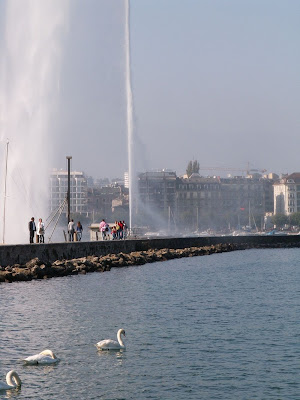


My flat mate Ruud - he went for on Saturday around the lake, I followed with my bike. Here are some pictures of what we see when we run here...


Before that, in the morning, we explored the market... Very cheap vegetables and fruits. Sunday I made a pumpkin soup that was pretty good (although not as good as Amanda's).


And this is my street... Litteraly two minutes from the lake

Sunday, 14 October 2007

Voir Dublin et mourir....

It has always been a dream of mine to visit Dublin and when Niamh, one of my Dublin colleagues’ and friend, invited me for her birthday in September, I didn’t have to think twice about going or not.

I finished work on Tuesday, packed my stuff for my six months expatriate trip to Geneva and left for Dublin on Wednesday.

Dublin is obviously a capital but still it’s not huge like London or Paris.You can walk everywhere, although I have to confess by Friday my feet where killing me, everything is cramped in the city centre. Wednesday is decided to have a general walk. I only had a few days and didn’t really want to miss anything. One of Niamh’s colleagues gives me some tips and with my map I can manage perfectly well. And anyhow, if you stay on a corner looking a bit puzzled, people come immediately to offer assistance… There is no way you can get lost in Dublin.

It’s a very interesting city if you like architecture. Houses are in Victorian style, covered in laurel and you kind of feel like you’re walking in an historic movie. Nearly every house has also a copper plate with the name of some famous Irish bloke who was born, lived or died in the house. I guess the sport in Dublin is to find a house without a copper plate!


Everything is also bilingual: English and Gaelic. The later is totally unpronounceable to me and Niamh and her flat mates have great fun hearing me trying to pronounce their cities.


One of my first visits was Trinity College. Beautiful building, interesting history but what makes it all worthwhile is the history society guided tours. Elisabeth, one of the guides, makes it a funny and very different visit from what you can expect. Apparently until 30 years ago Catholics were not welcome at Trinity College. Mary Robinson, former Prime Minister, had to ask for special permission to her bishop to attend Uni.


Elisabeth has also a very funny way of describing how students live. In some dorms, there are no showers or toilets and students have to go outside. In a girls’ dorm there was only one plug per floor until one year ago. You can imagine how difficult it was with your mobile, laptop, ipod charger and hairdryers. Another funny story is the acceptance of girls at Trinity. The story goes that George Provost, one of the most adamant opponents, apparently said “over my dead body” and actually died the day after the new regulation was passed. After the tour I went for lunch in the university cafeteria I think I looked young and lost enough to pass on for an Erasmus student ☺


The rest of my Dublin visit was pretty typical of any tourist: St Patrick’s cathedral, Christ church, going to see a live Irish band play music, visiting the James Joyce museum and Oscar Wilde’s house. One of the most beautiful places I’ve been during my three-day stay was the National Library. An exhibition about the Irish poet Yeats was organised but actually if you go there don’t hesitate about going upstairs to visit the library itself.


I was supposed to stay until Sunday, 16th September, leaving afterwards for Gairloch (Scotland) with Amanda, Archie and Pradeep (he plan was to rent a house and stay in Scotland for a week, enjoying nature, bike rides and walking). Niamh was celebrating her thirties’ birthday on Saturday night.


Unfortunately, the Belgian police phoned me on Friday evening to tell me that my dad had died. Apparently he fell down his stairs at home some days before and the neighbours got worried. Small consolation is that the doctor told me that he died instantly and probably didn’t suffer.

Niamh and her flat mates immediately brought me back to the airport, not before giving me the “alternative” tour of Dublin. Niamh’s boyfriend Mike really made this horrific morning pass well. At the airport, they all spit in different groups, queuing to the different companies to find me the cheapest and fastest way back home. Sadly, there wasn’t a direct flight to Brussels but British midland gave me their cheapest ticket but also gave me access to their business lounge, so I could relax. That made really the difference as well. I don’t think I could have managed 5 hours in the middle of Heathrow airport with screaming kids and people coming back from holidays.